Showing posts with label Ireland. Show all posts

Tuesday, 20 September 2022

UK State Terrified Chris Kaba-related Black-led Uprising will Destroy its Hyper-Monarchist Narrative


UK State Terrified Chris Kaba-related Black-led Uprising will Destroy its Hyper-Monarchist Narrative

- State attempting to keep Chris Kaba campaign quiet and ineffective

- Importance of employing quick effective strategic grassroots direct-actions around #ChrisKaba justice campaign

- Grassroots Fenians led the way in political resistance to the Monarchy

- British left terrified of street-protest against Monarchy, instead hiding on (anti-)social media

The Queen died and immediately the Brit colonial-capitalist ruling classes sighed in profound relief that their labour lieutenants in the trade union leadership - CWU/Ward, RMT/Lynch/Gordon/Dempsey etc - actually turned out to be more loyal to the Monarchy than even the bourgeoisie! A historic sell-out in the working class trade union movement that exposed the Monarchist loyalty and leanings of those in the case of Lynch and Dempsey like to bandy around their apparent political affiliations with leading Irish republican socialist James Connolly. 

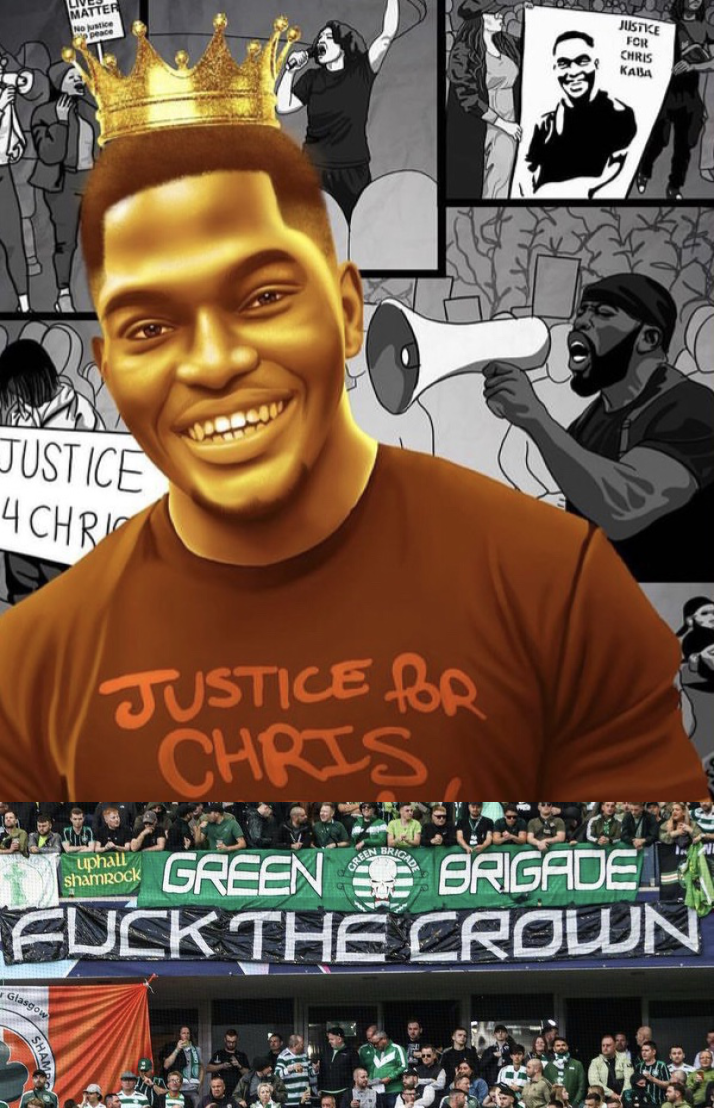
However, just as the sell-out was announced on the morning after Elizabeth Windsor's death the police shoot-to-kill of 24yr old Chris Kaba in Lambeth, South London set off again the pattern of state killing of a working class black youth and the resultant outpouring of grief, anger and determination of black and allied working class people seething with a sense of injustice and seeking to get that justice, many would like to in the words of Malcolm X to 'declare their/our right on this earth to for Chris Kaba and the Black community to be treated as a human being, to be respected as a human being, which we/they intend to bring into existence by any means necessary'. As soon as the colonial capitalist state removed one irritation: the strike wave, another wave of humanity asserted itself around the martyrdom of Chris Kaba.

The preparations for the death of Liz Windsor have been years in the making, a weaponisation of her death for the state to deepen its control over the great unwashed domestically and globally. In this context the possible uprising of the Black and poor youth at this time around Chris Kaba is something the state wants to avoid at all costs. The spectre of the 5-day national uprising after the shoot-to-kill of Mark Duggan on Aug 04 2011 haunts the ruling classes. 

The August 2011 Uprising haunts the state and lives-on as a glorious folk tale on the council estates across the country. Mark Duggan's 21yr old son Bandokay , a well-known rapper from the Broadwater Farm-based 'Original Farm Boys' crew/music group, often speaks about the uprisings on the many interviews on social media. These interviews and the music of OFB / Bandokay keeps the Uprising alive in the minds and imaginations of our youths beyond that which they hear in conversations amongst their older peers and family. Of course Broadwater Farm council estate itself is a militant symbol of Black working class-led resistance and victories against the British state especially due to the Uprising there on Oct 6 1984.

The state quickly announced a homicide investigation into the police officer who shot dead Chris Kaba. And then quickly announced that the officer was suspended (on full-pay, no doubt), angering his colleagues who threatened to hand in their weapons. Please do, thank you. Now it seems the family are imminently going to receive the body-cam footage. Labour Party MPs were quick to make statements pretending to be in synpathy with the Chris Kaba family while they daily collaborate with the state to deliver torture and death to our people on the council estates. Labour Party MP's were at the Chris Kaba protest in Whitehall where Diane Abbott was booed by Black youths for demanding everyone keeps everything peaceful. 

It is globally known that if your loved one is killed you go out with all your peoples and you make as much noise and destruction to show that the injustice will not go without resistance, hence the meaning of the slogan: no justice, no peace. The two-week Black-led uprising following the martyrdom of George Floyd is a case in point. There are alternatively many peaceful means by which the same aims can be met. 

The point of tactics is to achieve strategies of rallying further sections of the grassroots, building a broad united front, and to show the powers that be that we can apply direct pressure to ensure that they cannot oppress us without consequences to them. Such peaceful direction actions could be occupations and sit-ins of strategic institutions of the police, council etc; non-violent direct actions could be a on-going rolling hunger strike-tents at Brixton police station or New Scotland Yard; to peacefully block the transport system of the capital which is easily done with quite few people. With the imaginations of the grassroots many other things can be done. Ideally all tactics should be deployed all at once. 

The Chris Kaba justice campaign has grassroots backing to do so. The grassroots are ready for action but lack the leadership , determination themselves and organisations necessary for what we need to do for Chris Kaba and for everyone in defending them against further death and injury by the state, Realistically, it is probably unlikely that the grassroots will rise-up but we cannot but point to what decades, generations and centuries of our resistance informs us to do. We stand with our martyrs and ancestors whose sacrifices meant that we live today, there is no alternative to our advocacy.

The Sinn Fein leadership continue the political rationale of the British colonial 'good friday agreement' which means SF members have been strictly instructed to the nutty colonial monarchist sentiments of the unionist community in the occupied 6 counties. So heartbreaking and embarrassing to see SF leaders Alex Maskey and Michell O'Neil schmooze with king charles the turd and try to spin it as something positive for Irish people. 

This should not take away from the fact that the real opposition to the uk monarchy at the grassroots has been led by Irish Fenians / Irish Republicans. Be it the slogan against the king on Black Mountain by Belfast, the 'fuck your crown' banner drop by the Green Brigade in the stadium and the only street protest called against the monarchy in Belfast too. This current Brit monarchist hype is being used to further push away any chance of Scottish independence or Irish reunification. The monarchy doesn't just handover the break-up of its union and rule, it only does so when there is an escalating mass pressure from the colonised masses, of which currently there is an absence. 

While one might criticise the SF leadership, what SF have done in the past and still today are head and shoulders above the pathetic state of the British (colonial) left who have firmly stayed in their bedrooms looking nervously out of their windows into the real world while writing some posturing nonsense on social media. We say: fight by any means necessary for justice for Chris Kaba, against the racist anti-working class brutality of the brit state. As we go forward the global system of colonial-capitalism is going to deepen even further to terror which it is inflicting on workers and peasants the world over, this increasingly pressure on us including in Britain and Ireland will push all the oppressed to react. How and when, we don't know, but the science of repression and resistance is a universal and permanent one. 


Further watching:

What to do when the state kills one of us: 'Ultraviolence': https://vimeo.com/570908985


Sunday, 15 May 2016

MXM Easter Rising Event Report - 'The Most Important 1916 Centenary Event'

'This is the most important 1916 event I have addressed' - Bernadette Devlin MacAliskey
Event report on Malcolm X Movement's and Crimes of Britain's event 100 Years Since the Irish Easter Uprising

Friday 13 yesterday turned out to be a fantastic day to salute the revolutionaries and martyrs of the great Irish Easter Uprising in 1916.day the 13th there was a tiny bit of bad luck that was overshadowed by an enormously informative and inspiring evening. The Malcolm X Movement's event was entitled 100 Years Since the Irish Easter Uprising, and we were honoured to have two special guests, both of whom very kindly flew in especially for this event, being former PLO Ambassador to Ireland and veteran senior Palestinian revolutionary Saeb Shaath, and the most well known and respected living female Irish revolutionary Bernadette Devlin MacAliskey. It was also a great privilege to have on the panel leading global Black radical decolonial scholar Hakim Adi and finally our young comrade Gerard MacNamara from the excellent and highly successful social media project Crimes of Britain as well as MXM coordinator Sukant Chandan chairing the event. The revolutionary 'craic' was being had in full effect! The room was packed with over 80 people in total in attendance.

Sukant Chandan opened the event for the MXM as chair by stating that the historical importance of the 1916 Uprising are many including the fact that it was the only anti-imperialist uprising in Europe during the first imperialist war, and that it electrified the anti-colonial peoples especially of the British empire as it struck the enemy right on its doorstep at such a critical moment. Chandan stated the reason the MXM has put on this event and the reason that of all the centenary commemorations across the world why this one stands out is due to the fact that no one until this event has brought clearly the global anti-imperialist analysis from Africa and Asia into the analysis to 1916. Chandan singled out Peter Middleton for particular thanks who was in attendance and whom in the 1990s, was a leading political organiser in London for Irish freedom, including amongst many other the weekly protests outside Downing Street.

Gerard MacNamara from Crimes of Britain and co-organisers of this event made his maiden public speech, and a brilliant talk outlining the history of British colonial looting and genocide against the Irish people, in the forced famines against the Irish for example in taking away millions of gallons of butter away from the Irish, tearing off roofs of houses so people could not squat them and how this colonial supremacism AKA white supremacy/racism against the Irish is still normalised today. MacNamara stated that Channel 4 recently floated the idea of having a comedy on the Irish famine. While at the time of the famines a British army colonel stated: "you must pay or get out, I tell you, I care no more about turning you out on the roadside than I do about shooting the bird which flies across my path".

Hakim Adi made a very informative speech as to how the Irish struggle had inspired Black / Pan-African liberation, including stating how Claude McKay, a leading Halrem Renaissance man of Jamaican heritage spent time in London uniting with Irish revolutionaries in the 1930s. Adi also relayed how much the Irish struggle informed many ideas in the leader of the millions-strong global United Negro Improvement Association, Marcus Garvey, who named his own building Liberty Hall after the Irish revolutionaries building in Dublin also called Liberty Hall that is still a trade union hub today.

Saeb Shaath gave a impassioned contribution imparting knowledge to the attendees as to the plots of the British colonialists in their oppression of Ireland and how they developed their oppression to then export to the rest of the people of the British colonies. Shaath focused especially on colonial partition, of which the British are the global masters, and how they have divided and partitioned many countries and regions, including Palestine and the Arab world. Shaath then recounted the current situation of British imperialist meddling in the North African and Middle Eastern regions. There were many cheers and applause for Palestinian liberation throughout his contribution from the audience.

Bernadette Devlin MacAliskey very generously flew in from Derry especially for this event but the flight was delayed for an hour so she entered the event at 830pm. However, she was welcomed by great cheering and applause and everyone spontaneously and en-masse chanted her name in unison to welcome her, reflecting the great respect and admiration her role and sacrifices for Irish freedom and socialism inspires. Devlin spoke in her typically eloquent and articulate manner on a number of issues that captivated all in attendance. She stated that she has spoken at many centenary events, events attended by great numbers of people but that the MXM event she was addressing was the most important one that she had spoken at because while Irish people have been commemorating and saluting 1916 for 99 years, it was an event like this that brought together all the global dimensions and impact of 1916. Devlin stated that the Irish people who were starved out of Ireland by the British colonialists first went to the North Americas as Irish speakers not English speakers. Devlin explained that they were not a part of the colonial 'white' club, and that there was a process that turned Irish people into white people, and that was through realising that if they spoke English that they could not be visibly defined as being phenotypically be seen as anything other than white. Devlin stated that she did not identify with those of Irish heritage that saw themselves as white in the USA, but she identified closely with the Black Panthers, with the Native American movement and other radical movements. Devlin's contribution was met with great applause and a long standing ovation.

The event saw young Black and Asian and radical white British youth and Irish patriots and revolutionaries gather together to understand each other and to unite with each other. No one else is doing this important work in England in bringing together communities of resistance, communities of oppressed peoples.

The full speeches have been recorded on video and will be uploaded in the coming two weeks and will be shared across MXM accounts and supporters on social media.

The MXM would like to give a big thank you to all our speakers, and all those who attended and put in the hard work to make this event a success.

Malcolm X Movement facebook

Next MXM public event:
1926 General Strike: 9 Days That Shook Britain

MXM twitter

Email: 2015mxm@gmail.com


Tuesday, 29 March 2016

Easter Rising Rebels Vindicated: Unification of Ireland Remains the Issue

Malcolm X Movement coordinator Dan Glazebrook writes the following below, in an article published by the leading USA anti-imperialist left website - Counterpunch.

Please note that the MXM is holding an event to commemorate the centenary anniversary of the Easter Uprising on Friday 13 May 6pm at the Marx Memorial Library in London (EC1R 0DU), with special guest speaker and leading republican socialist and feminist - Bernadette MacAliskey, please see the Facebook event page here and the event page on this website here.


Irish Unification Remains the Issue: Easter Rebels Vindicated by New Report

When members of the Irish Volunteers and Irish Citizen Army took up arms and proclaimed an Irish republic on Easter Monday 1916, they sought, first and foremost, an independent nation based on the political equality of all its citizens. But they also believed that independence would put an end to the economic dismemberment that British rule had visited on the country to such devastating effect over the previous centuries.

Following the closure of the Irish parliament and the country’s forced incorporation into the UK in 1801, Britain imposed a vicious form of ‘free trade’ designed to strangle Ireland’s nascent manufacturing industry lest it come to rival that of the English mainland. Ireland was doomed by successive Acts of Parliament to remain an agricultural adjunct to British industry, growing wheat to feed the laboring masses in Liverpool, Manchester and London, whilst its own, increasingly pauperized, population lived on a precarious diet of potatoes.

The Great Famine of 1849-52 was the result: despite a blight of the potato crop on which the vast majority of Irish survived, Irish wheat continued to flow to England, and the liberal government closed down the soup kitchens in accordance with the inhuman doctrine of laissez-faire and ‘self-help’. By the time the famine ended, the population had been reduced by a quarter, with one million starved to death and a further million fled to America. Freed from the depredations of British rule, the rebels believed, Ireland would undoubtedly be able to lift herself out of such debilitating levels of poverty and suffering.

Indeed, even the industrial development that did later occur was strictly limited to the protestant-dominated counties in Ireland’s Northeast. And although Belfast had, by the dawn of the twentieth century, become a hub of the UK shipbuilding industry, the sectarian policy of both employers and unions ensured that it was only protestants (the descendants of British colonial settlers) who were employed there, and never the indigenous (Catholic) population – a fact seemingly whitewashed out of modern British accounts. As one republican told me when I visited the City recently, “although the Titanic was built just down the road, as far as we were concerned, it might as well have been built on Mars”.

Despite briefly taking control of the Irish capital, the Easter rebels were soon overwhelmed by British troops and after six days, the uprising was over. Despite surrendering, sixteen of the rebellion’s leaders were then executed by the British, including one – James Connolly – who had to be strapped to a chair in front of the firing squad due to his injuries.

Despite the suppression of the rising, a mere six years later independence was achieved. But it was not the unified republic for which the rebels had fought. Following the Irish war of independence of 1918-1921, Britain finally negotiated a partial withdrawal; but it made sure it clung on to the wealthiest, and only industrialised, region: the ‘six counties’ of Ulster, which were to remain part of the UK.

The decline of Ulster’s shipbuilding industry, however, began in the 1960s following the growth of air travel and competition from abroad. Since then, Northern Ireland has been largely portrayed, in a twentieth century reboot of the ‘white man’s burden’, as a drain on the British economy which the British government has been selflessly bearing, at great cost to its own interests, solely for the good of the region’s inhabitants. The implication is that the Irish economy would be insufferably bogged down by having to take responsibility for the six counties of Ulster, and only a ‘great power’ like Britain is able to keep the region afloat. Uniting the country, so the narrative goes, might satisfy the deluded fantasies of a few zealous ideologues, but the price tag would be plunging living standards for the Irish people.

A detailed academic study published last week, however, has blown this colonial mythology out of the water. The report, entitled Modeling Irish Unification, was overseen by Dr Kurt Hubner, director of the institute of European Studies at the prestigious University of British Colombia in Canada, and concludes that “Political and economic unification of the North and South would likely result in a sizeable boost in economic output and incomes in the North and a smaller boost in the [South of Ireland].” To be exact, the authors of the study calculated that the combined economies of Northern Ireland and the Republic could grow by over €35 billion over eight years if they reunified.

The UK’s Financial Times wrote that “If the economy of Northern Ireland adopted the Republic’s tax regime and the euro, the resulting productivity increases and lower cost of trade could cause the province’s economic output per head to rise by as much as 7.5 per cent, according to the report, which was compiled by academics in Canada and Europe. Northern Ireland would benefit disproportionately because of the “catch-up effect”. In other words, it would open up an economy that is effectively closed, since most of its trade is with the rest of the UK, while living standards are lower, the report says”.

Indeed, the report is particularly damning on the impact of British rule on living conditions in the North: “The economies of Ireland north and south are interlinked and interdependent, but they are not aligned,” it says, adding that Northern Ireland “has relatively low living standards, inward-oriented industrial policies, high levels of output in low value-added sectors, a small private sector, and an overreliance on the public sector”.

These findings echo other recent reports that underline how Northern Ireland has gone from being the wealthiest to the poorest part of Ireland since being torn from the rest of the country in 1922. The FT notes, for example, that “the republic’s economy grew 7.8 per cent in 2015, while the North’s shrank by 0.8 per cent in the third quarter of last year.” And a recent report by the Rowntree Foundation has revealed that around one fifth of the population live in poverty, “with significantly lower employment and levels of pay hindering attempts to address poverty”. It also found that average weekly pay was around £20 lower today than a decade ago for all but the wealthiest, with the low-paid even worse off than this. Such are the fruits of British rule in Ulster.

One might have thought that the Canadian report, representing the first rigorous academic study of the economic impact of unification, and with findings that so clearly fly in the face of the ‘established wisdom’, ought to have been headline news in the UK.

After all, it has certainly been taken seriously by experts in the field. Marcus Noland, Executive Vice-President and Director of Studies at the Peterson Institute for International Economics in Washington, for example, called Modelling Irish Unification “an important, timely examination of the economics of Irish unification, applying state-of-the-art modelling techniques to the issue at hand. The modelling work illustrates a variety of channels which are likely to be at play in the Irish case and concludes that Irish unification would be economically beneficial to both parts of the island, especially for smaller, poorer, Northern Ireland.”

Michael Burke, meanwhile, economic consultant and former Senior International Economist at Citibank in London, said that “The issue of the benefits of a unified Irish economy are unfortunately largely overlooked. This paper goes some way to correcting that and will help develop discussion in this neglected area.”

As far as the British press is concerned, however, it can stay neglected. In fact, the only reference I could find to the report in any British newspaper was the story quoted above in the Financial Times (famously dubbed by Noam Chomsky ‘the only paper that tells the truth’, designed, as it is, to provide its wealthy readership with accurate information to guide their investment decisions).

As for the rest, they have apparently been too busy mocking the SNP over the devastating impact of low oil prices on the Scottish oil industry which, it is claimed, would make independence untenable. This, of course, fits in much better with the prevailing British media narrative on issues of self-determination, which essentially boils down to a chauvinistic claim that ‘these impudent nations could never survive without us’. The truth, of course, is that the Easter rebels were right: it is surviving with dignity within the UK that is fast becoming the real impossibility.

Saturday, 26 March 2016

MXM Film Festival in Ireland: 'Translating Malcolm X Into Irish'


For some of the younger people of Northern Ireland, “it was the first time they heard Malcolm X’s own words speaking about ‘rejecting the white man,’ developing independence Black liberation organizations, rejecting the dehumanization from the white man, and being inspired by the ‘darker nations’ of Africa and Asia uniting against European colonialism.”

Translating Malcolm X into Irish: Malcolm X Film Festival’s First Historic Event in West Belfast
By Sukant Chandan, one of the MXM coordinators team

We arrived into Ireland on Friday 13th March 2015 as the latest political crisis was gripping this small section of the island of Ireland. Left-wing Irish Republican party Sinn Fein had blocked an austerity budget leading to the freezing of the budget for Northern Ireland. Directly related to this was a public workers one day strike the day our Malcolm X Movement delegation arrived at Belfast International airport, so we had to catch a taxi to West Belfast where we are staying with a local grassroots Irish republican socialist activist and friend. Sitting in the front of the taxi and chatting with the driver, I went through the usual careful and subtle probing as to where he stood in the British colonial-induced division in the six counties. Was he an Irish nationalist (who happen to be overwhelmingly Catholics) who united with the “third world” anti-imperialists, including the ANC, and supported the total end to British rule and the reunification of their country, colonized and partitioned by British colonialism? Or was he a Unionist (who happen to be overwhelmingly Protestants) who were historically planted into Ireland as colonial settlers and who more recently allied to Apartheid South Africa and are still largely allied to racist right-wing forces and the white settler state of Israel and want the six counties to remain eternally a part of the United Kingdom?

As we passed the beautiful hills of Cavehill and Black Mountain that immediately surround Belfast city we discussed the budget crisis at which point the taxi driver mentioned something along the lines of “those who have always held power here do not like to see that changing,” which clearly indicated to me that he was probably an Irish nationalist. It turned out he was and I felt more comfortable and we got into a big conversation whereby I mostly asked questions and he, like it seems so many people who lived through the “Troubles,” were more than happy to impart their usually insightful and sophisticated analysis informed by their experiencing of the horrors of the conflict there.

Towards the end of the conversation we discussed British covert operations in their dirty war in Ireland, with “the Brits” supporting the pro-Unionists “Loyalist” death squads, through what is infamously known as collusion, reminding me of the same covert operations and collusion with neo-colonial death squads in the Muslims world. Our journey came to an end, we bid farewell and he wished us a good stay in West Belfast.

“The murals reflected the Irish republicans’ affinity and solidarity with the people of Palestine and South Africa against white supremacy rule, but featured mostly their own revolutionary martyrs.”

It felt great to return to West Belfast, my second time there, and my fifth time in Ireland since 1999, every one of those visits I come to partake in political and cultural work with the Irish revolutionaries who are in Sinn Fein and independent Irish republican socialists and anti-imperialists. Belfast and Derry hold some of the most politicized anti-imperialist and socialist working class communities in the entire “West,” and as such is a primary example and inspiration of how a brutally colonized people (indeed the first colonized nation of English colonialism 800 years ago) can resist, organize and steadily build their politics in an inter-generational time frame.

We arrived to deliver the first of seven events in the First Annual Malcolm X Film Festival, taking place at the well-known cultural centre, Culturlann on the historic Falls Road in West Belfast. However, we had the full afternoon before the event day to have a walk around Falls Road and see the many revolutionary murals painted on gable ends of terraced homes and the famous rows of murals showing brightly and colorfully the recent and ancient history of the struggle of Irish freedom from colonial rule.

Leila Khaled speaking at the Malcolm X Film Festival
While West Belfast remains palpably politicized, one can still feel the Troubles rescinding into the background in the community with a new generation of young people and teenagers who were borne after the start of the peace process formally initiated by the Good Friday Agreement in 1998/1999. While social justice is a long way off there has been some increase of private investment. A shiny leisure center and a massive new shopping tower above the Milltown Cemetery where many of the martyrs for Irish freedom are buried.

We saw Palestinian revolutionary icon, leading PLO and PFLP member Leila Khaled, featured on a few murals. Khaled herself would be addressing the Malcolm X Film Festival the following day. The murals reflected the Irish republicans’ affinity and solidarity with the people of Palestine and South Africa against white supremacy rule, but featured mostly their own revolutionary martyrs, people like James Connolly and IRA prisoner of war and elected MP Bobby Sands whose mural has pride of place on the Falls.

While walking around the Falls our Irish host would greet and have a wee chat with people of the community who were all politically active in some way or another – either working with local youth, or whatever anti-imperialist and socialist activities they were committed to. This is a community that is pulsating with political discussion and activity, hardly spending any time on social media, but actually being socially embedded in real life and struggles with their community. We sat down for a snack and a tea with three young community activists and anti-imperialist socialists, two of them coming from solid revolutionary families with family members having served back in the conflict in the revolutionary national liberation armed movement of the Irish Republican Army, said by some to be unofficial armed wing of Sinn Fein.

Along with the great “craic,” hospitality and political discussions, the quick wit and charisma and intense discussions that seems to be nearly universal characteristics of the people, there were also instances of the trauma of living through a brutal war. Any working class community has its fair share of trauma, but add into the mix lots of shooting, massacres, torture and imprisonment, and it all adds up to a terrible mix that no humans should have to live through.

The Malcolm X Film Festival saw over 50 local activists attend the event the following day, which my revolutionary Basque Country comrade told me was a decent turn out in West Belfast considering the time and what was concurrently taking place. The event opened up with the first film montage of Malcolm X speaking on Civil Rights and Black Power in his last final years of speeches and interviews. There would be no one more fitting to speak on this panel than Bernadette MacAliskey, who became the most inspiring and audacious revolutionary at a very young age against the British Army’s occupation of the working class district of the Bogside in Derry. She took to the peoples barricades, helped to mobilize the youth and community against the British military police and army, got elected on a national liberation and socialist platform to parliament and remains to this day the youngest woman ever to have been elected. She was a leader of the Irish civil rights movement inspired by the Black civil rights movement in the USA and the undivided Indian peoples non-violent national liberation struggle. As with those historic examples, the oppressed Irish people’s struggle for non-violent change was met with brutality and massacres by the colonialists. The notorious Bloody Sunday Massacre was conducted in 1972 by the British state, killing 14 protestors and leadig to a further radicalization of the movement.

Bernadette MacAliskey speaking at the MXM Film Festival
Later in the evening, I was told by an Irish comrade that the event would have seen young activists hear for the first time people with English accents talking about anti-imperialism, socialism and the liberation of Ireland. It was the first time that they would hear someone non-white speaking about these things. And it was the first time they heard Malcolm X’s own words speaking about “rejecting the white man,” developing independence Black liberation organizations, rejecting the dehumanization from the white man, being inspired by the ‘darker nations’ of Africa and Asia uniting against European colonialism etc. Therefore Bernadette MacAliskey was the first of two Irish speakers at the event to ‘translate’ Malcolm X for the Irish audience. She recounted her experiences of going to the USA in the late 1960s and 1970s when she was a highly sort after speaker, invited by white feminists and relatively well-off Irish Americans who lived in houses that to MacAliskey “appeared like plush hotels” with “two toilets and three bathrooms” compared to the poor working class areas of Derry from where she came from, in which the struggle for better housing for Catholics and Irish nationalists was one of the primary issues in the civil rights struggle against the Irish apartheid system. She explained that the feminists in the USA had house servants who were Black or Brown, but she would find more common ground with those Black and Brown women than the white feminists and middle class Irish Americans. She said that she felt at home associating with the Black Panthers and the radical Puerto Rican anti-imperialist socialist group the Young Lords. Famously, MacAliskey was handed the keys to New York City that she instead gave to the Black Panthers. MacAliskey explained that she thought that one of the big problems of the Irish is that they think they are white and have white minds.

Dr Moussa Ibrahim speaks at the MXM Film Festival
Following MacAliskey was Dr. Moussa Ibrahim, the last media spokesperson for the Libyan Socialist Jamahirya government before NATO and its proxies destroyed it in 2011. Dr Ibrahim is still wanted by NATO who have put him on the red list on Interpol; he is still underground and a leading figure in the anti-NATO Libyan resistance. Dr Ibrahim eloquently explained that Malcolm X is a central figure for inspiration for the Libyan resistance. He continued to explain that part of the reason why Libya was destroyed was that like Malcolm X and Kwame Nkrumah and other African revolutionaries, Muammar Gaddafi was pioneering the capacity building of the African continent, and the African Union strategically aimed towards assisting in the liberation of Black people across the world. But the two things, Dr Ibrahim explained, that motivated NATO to destroy Libya was Gaddafi’s proposal for a gold-based African Dinar that would have ended the Dollar and Euro domination of Africa, and also the Global South military alliance that was being developed with Bolivia and Venezuela, a South Atlantic Treaty Organization to counter NATO. Dr. Ibrahim hoped that the Libyan and Irish people can reconnect to the unity that they previously developed, and many Irish activists attending were keen to nurture that unity once more. Dr Ibrahim also conveyed that Libya should be one of the most important Black Liberation struggles to give solidarity to on the planet as the general anti-NATO resistance in Libya is also united together with darker skinned or Black Libyans who have been systematically persecuted in acts of genocide by NATO’s proxies in Libya.

The second Irish speaker who translated Malcolm X for the Irish audience was former IRA prisoner of war and Sinn Fein member from Derry, Gerry MacLochlainn. MacLochlainn recounted how the Irish democrats of the 18th and 19th centuries mobilized to ensure that the Belfast port was not used in the genocidal industry of European slavery against African peoples. The most powerful thing MacLochlainn said and on which he finished was that the Irish people have to thank the British in a kind of way, thank them for ensuring that Ireland did not become a European colonizing power and instead because of the British colonial oppression of Ireland pushed the Irish into the camp of the global anti-imperialist movement against racism and colonialism.

I had to nearly pinch myself as I wondered if Ireland had ever seen such a discussion of white supremacy, colonialism and imperialism, resistance, liberation and Malcolm X with such an array of revolutionary speakers. Leila Khaled spoke about the importance of Malcolm X’s message of dignity and liberation of oppressed peoples, and emphasized that the death squads such as “Isis” are working for, and creations of, imperialism and Zionism to destroy the countries and communities in the region. Leila Khaled stressed that it was of primary urgent necessity that people must unite against these neo-colonial death squads. Leila Khaled and the whole room laughed when for the third time she could not understand the English of our Irish comrades and I had to “translate” the questions for her. I later commented and joked with Irish comrades that MacAliskey and MacLochlainn politically translated Malcolm X for the attendees, and I translated the contributions so Leila Khaled could understand. I suppose all of us who are resistant victims of colonialism have to make efforts to listen, learn and understand the differences in our accents and languages to better unite for our common liberation.

We completed our event and visit with discussions about how the Malcolm X Movement and the Irish activists and struggles will work closer together and build for the Second Annual Malcolm X Film Festival in 2016 which will be dedicated to, and working alongside, the Black Panthers to commemorate the 50th anniversary since the founding of another primary radical anti-imperialist and socialist movement from within the West. As the airplane pulled away from the land of Ireland and drifted back to the heart of colonialism and whiteness in London, the Malcolm X Movement delegation left Ireland satisfied that we had fulfilled part of our revolutionary duty to unite Malcolm X with the Irish in a common cause of anti-colonial liberation. There remains much uniting to be done.

Public event: 100 YEARS SINCE THE IRISH EASTER UPRISING: A Historic and Unique Blow to British Colonialism!


100YEARS SINCE THE IRISH EASTER UPRISING
A Historic and Unique Blow to British Colonialism!

The 1916 Irish Easter Uprising against British colonialism was one of the most important global revolutionary developments at the time, and shook the empire to its very core and inspired a new wave of revolutionary struggle against colonialism throughout Africa and Asia. This event seeks to bring this history and legacy to new generations of Black, Asian and working class anti-imperialist socialist youth. This event brings some the best of anti-imperialist voices to speak to this subject and to inform and inspire us.

SPECIAL GUEST SPEAKER: BERNADETTE MACALISKEY - A leader of the Bogside resistance, one of the youngest MPs ever and veteran republican socialist

SAEB SHAATH - Former PLO Ambassador to Ireland speaking on the impact of the Easter Uprising on the struggle of the Arab peoples against colonialism

HAKIM ADI - World renowned Black radical scholar and historian speaking on the impact of the Uprising on African liberation

Gerard MacNamara - From 'Crimes of Britain', speaking on the importance of the Uprising on anti-imperialist youth today

Chair: Sukant Chandan - A coordinator at the Malcolm X Movement

Other speakers tbc

Fri 13 May, 2016
Doors open at 6pm, 630pm sharp start, ends at 9pm
Marx Memorial Libray
37a, Clerkenwell Green, Farringdon EC1R 0DU
£5 suggested entry

This event is organised by the Malcolm X Movement and Crimes of Britain

Attending this event means that you are giving consent to possibly be in the video footage of the event which will be uploaded on social media.